01
Waveform
Displacement of a chosen point, tracked against one fixed frame so error does not walk away over hundreds of frames.
 Pronto Rosso
Flagship instrument · Visual vibrometry
Tremovis measures how a machine moves by tracking texture in high-frame-rate video, frame by frame, to a fraction of a pixel. What comes out is a displacement waveform and its spectrum: the kind of evidence a contact sensor gives, from a metre away, without touching anything.
Built for the surface that is too hot, too small, or too dangerous to touch — and for the moment you need to see which part is the one moving.
01 — The instrument
A vibrating machine moves its own texture across the sensor. A bolt head or a cast edge, displaced by a fraction of a pixel, changes the brightness pattern in a way that can be measured. Tremovis reports the frequencies in that movement, whether two points move together or against each other, and how much confidence the capture can support.
It is enough to find an unbalance, a looseness, a misalignment, a resonance, or a change since the last visit. It is not a substitute for a contact accelerometer on a machine that already has one.
01
Displacement of a chosen point, tracked against one fixed frame so error does not walk away over hundreds of frames.
02
Peak amplitude, in the unit the graph names. Window, sample rate, duration, and bin width are printed on the figure.
03
The first point minus the second. A positive value means the first point leads. The order you placed is the order that is reported.
04
A, B, C, or a refusal. Computed from the capture. Every result lists its limits, including the ones graded A.
02 — On the phone
Screens from Tremovis on iPhone. Colour on the device means something: a live trace, a caution, or a refusal.
03 — Method
Advanced mode walks the measurement. Easy mode records or imports and decides the rest. Either way, a number the video cannot support is refused, with the specific thing to change.
Trim the clip and draw the area around the part you mean. A whole-frame reading will happily report the wall behind it.
Confirm what holds still. Stabilization removes camera movement, and it cannot separate a shake at the machine’s own frequency from the machine.
Place points on texture: the bolt, the casting seam, the label edge. A smooth painted panel has nothing for a tracker to hold.
Read the spectrum. Peaks closer than one bin are one peak, however sharp the graph looks. Bin width is on the figure.
Motion magnification shows where movement is. It is never the basis for a number, and it will not render a band the tracked data does not contain.
Findings, limitations, and the recapture if the grade is short. Export a project when the work has to leave the phone.
Easy
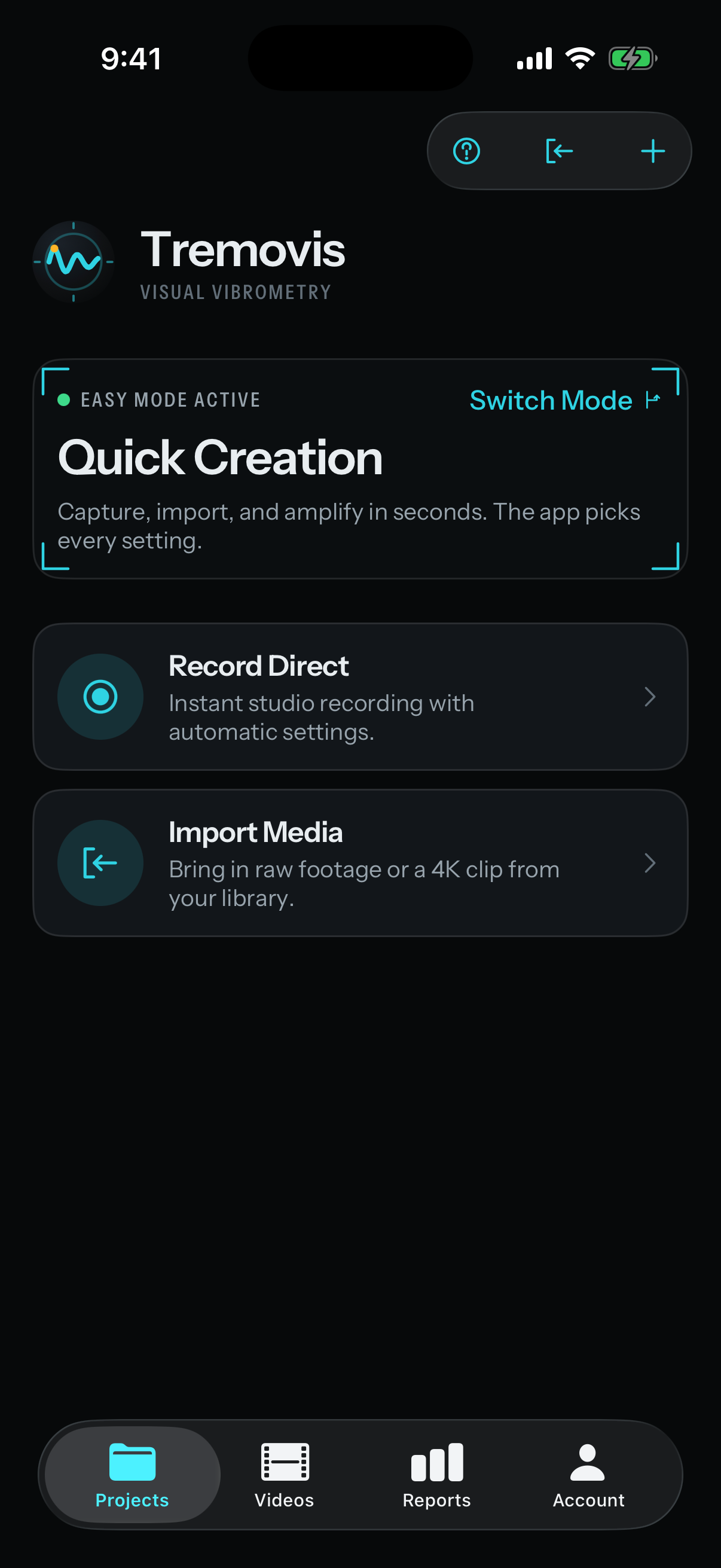
Record direct, or bring in footage. Automatic magnification and a frequency reading. The app picks every setting.
Advanced
The full workspace, filed against a named machine and a visit, so the next visit can be compared with the last. An on-device assistant explains and drafts. It never produces a frequency, a phase, an amplitude, or a grade.
04 — Evidence
The capture supports the finding as stated. The limitations are still listed. There is no measurement here without conditions.
The frequency holds. Something is marginal, and the result names which: light, brace, duration, texture, or how near a limit the peak sits.
A lead to confirm, not a measurement. The app is declining to present the number as better than the video it came from.
A refusal, not a lower grade. It comes with the specific change: brace the phone, add light, record longer, move closer, raise the frame rate.
The one clip with a known answer
Tremovis ships with a sample whose motion was written, not filmed. The target moves at exactly 30 Hz with a peak of two pixels. Measure it. If the instrument reports 30 Hz, the measurement path on that device is working — before a camera is pointed at anything that matters.
05 — The practice
Pronto Rosso is an engineering and technology practice. We do technical due diligence for people deciding whether a technology is what it claims: design history, analysis, materials, fitness for service, standards, and the software underneath.
Tremovis is the flagship — the instrument we built when the question was vibration and the surface could not be touched. Further instruments are in development. The standard does not change from one to the next: say what was measured, say what was not, and never let a picture stand in for a number.
Engineering and software, in one practice. Due diligence when you are buying a technology. Tremovis when you are standing in front of a machine.
Design data, history, system records, and equipment logs — how a technology matured, and where it has already failed.
Third-party finite element work, structural integrity, stress, vibration, and thermal performance under the loads that matter.
Non-destructive testing and metallurgical review. Defects that a drawing will not show, and whether the material is the one that was specified.
Readiness for service or manufacture. Fatigue, corrosion, remaining life, and the repairs that would actually change the outcome.
Compliance against the codes the equipment will be held to, before a regulatory problem becomes the finding.
Applications, algorithms, and architecture — from the system as it runs today to whether it can be trusted as it scales.
How an engagement runs
06 — Contact
A machine, a technology you are evaluating, or Tremovis itself.